Should two Public Service Commissioners be reappointed? Is there any way for the public to weigh in on this?
What exactly is the Florida Public Service Commission?
On paper, the PSC is supposed to regulate utilities for the benefit of Florida’s residents. They also oversee significant parts of development of data/AI centers.
The Florida Public Service Commission is committed to making sure that Florida’s consumers receive some of their most essential services — electric, natural gas, telephone, water, and wastewater — in a safe, reasonable, and reliable manner.
In reality, the five Governor DeSantis appointed commissioners tend to benefit utilities with the majority of their rulings.
Earlier this year, the Florida Phoenix reported that
According to research conducted by the group Food & Water Watch, the PSC since 2020 has approved increasing Florida utility bills by 85% for Tampa Electric customers, 44% for Duke Energy consumers, and 38% for Florida Power & Light (FPL) customers, of which there are approximately 12 million in the state.
Wondering how much of your bill is pure profit for your utility’s investors? The Energy & Policy Institute released a report earlier this year focusing on the absurd profits private utilities make, and included a calculator so you can see for yourself. For a small house in St. Pete, a $150 electric bill yields slightly more than $25 in return on equity (ROE), aka, pure profit, for Duke energy. That’s 16.6%, 7% higher than national average rates.
We would be remiss if we did not mention that Florida Power and Light reported a net profit of $5+ billion, after receiving a humungous rate increase. Overall, Duke Energy also made almost $5 billion in profit, attributing $700-800 million of that to Florida. Local utility, TECO, reported a $607 million profit in 2025. And just in case you think an energy provider in Florida named Florida Public Utilities is not a privately owned, profit making company, you’re wrong. They maintain a 20+% profit margin.
To the PSC’s credit, they did work with the Office of Public Counsel to get refunds from Florida utilities who overcharged for hurricane repairs and preparedness. Florida households saw an average of $12 return on their bills.
There is another state office which does actually advocate for Florida consumers, the Florida Office of Public Counsel. Their slogan is Advocating for Fair Utility Rates. While they have pushed back on many of the PSC’s decisions, they seem kind of ignored by the PSC.
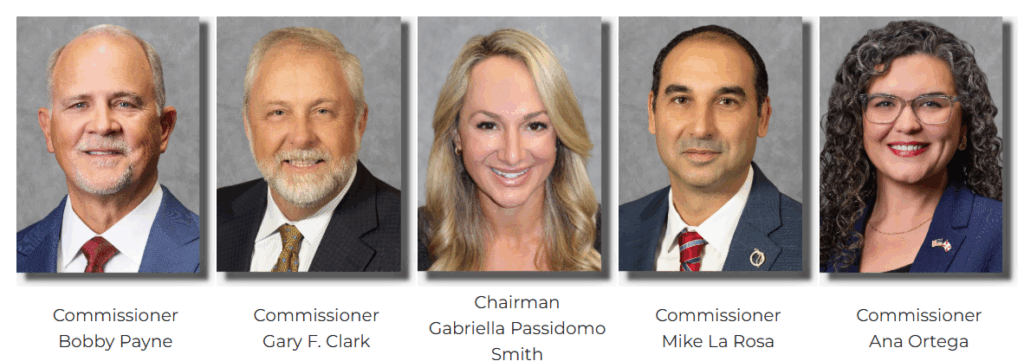
Gabriella Passidomo Smith
Gabriella Passidomo Smith, daughter of former state Senate President Kathleen Passidomo, R, Naples, appointed to the PSC in 2021, currently serves as the Chair of the PSC. She has made news for approving what’s called the biggest rate hike in history’ for Florida Power and Light (almost $7 billion).
Passidomo Smith stated, upon becoming the Chair of the commission,
Transparency will be a central theme of my chairmanship,” … “Customers deserve to understand why decisions are made, how rates are determined, and how and when they can meaningfully participate.
Hopefully at some point that will include easily found minutes of meetings and records of commission votes.
Gary F. Clark
Bringing a background of both public service and electric utility management in Florida, Gary F. Clark was first appointed to the PSC in 2017 by the Governor Rick Scott, and reappointed by DeSantis. He served in the FL Department of Environmental Protection. Prior to that, he spent 20 years with the West Florida Electric Cooperative. The WFEC is a member owned, nonprofit utility. Clark has served as Chair of the PSC.
Is there a way for the public to weigh in?
Public Service Commissioners are not elected by the public, but have to go through a confirmation process through the Florida legislature. The Public Service Commission Nominating Council is composed of twelve appointees of the state senate and house leaders. Each leader appoints at least three members of their body, one from the opposing party, and others. It hasn’t been easy to find out who is on that commission. Otherwise, we encourage Floridians to contact their elected state officials to share their opinion on how effective these commissioners have been in protecting residents from the greed of utility companies.
You can find your state senator here, and your state representative here.